The Football Game known as Vietnam: A critique of “The Truth about the Vietnam War” – a PragerU video by Bruce Herschensohn

It’s 1972. Coach “Bulldog” Dick Nixon is marching his team steadily toward the end zone. A few more yards and the game is won. Victory is ours! Hoping to fake the Vietnamese defense, Nixon calls for a quarterback sneak. Everything is set. The snap is delivered. But wait! The quarterback freezes. What?!  Oh no, it’s just then that Nixon realizes his QB is a limp-wristed Democrat. Holy Hell! Rather than leaping into and over the defensive line, the QB appears to have retreated from it. A moment later he is blindsided by a linebacker half his size who strips him of the ball and runs 98-yards for a Vietnamese touchdown! Time has run out. The game is lost. And, the Democrats are to blame. 

Some say there’s a link between America’s love affair with football and war.  Others don’t seem to see a difference. Such is the perspective of former Nixon speechwriter Bruce Herschensohn in his PragerU video “The Truth about the Vietnam War.” A more fitting title would be “What we Wished was the Truth about Vietnam” or “The Fairytale that was Vietnam.”

Mr. Herschensohn is a skilled writer and orator. Much like Dick Cheney. You listen to him and – absent the facts or a desire to get to them – you believe what you hear. Articulate and bespectacled it’s hard to imagine Herschensohn not espousing the truth. Guys like this just don’t lie. Besides his conclusion plays to a common narrative: we lost in Vietnam because of limp-wristed Democrats – those weak-minded individuals who prefer life over death. What more needs to be said?

In under 5 minutes Herschensohn explains everything he thinks you need to know about the Vietnam War.  For those serious about learning (some) facts about Vietnam, his pitch is followed by a 5-question multiple choice quiz. Nice tidbits of information for promoting the lore of America, regardless of how incomplete. I don’t mind bias; it’s human nature. It’s not so much that Herschensohn misinforms it’s what he leaves out that is most worthy of criticism.

Reading the text of Herschensohn’s video helps to strip away the man and lets his words stand on their own. Very quickly those words crumble under the weight of history. Here are six specifics to back-up my claim.

1. In his opening sentence Herschensohn says: “Decades back, in late 1972, South Vietnam and the United States were winning the Vietnam War decisively by every conceivable measure.”

By “every conceivable measure” I presume Herschensohn is referring to the metrics created by Defense Secretary McNamara and used by General Westmoreland and his successor General Abrams. Both men famously reported that they could “see the light at the end of the tunnel.” Then it was realized that tunnels in Vietnam were like the ground above – unpredictable and dark. Measured by bombs dropped, land controlled, and enemies killed, our measures showed that we were winning the war. The only problem was that one key variable was missing: the sentiment of the Vietnamese people and the determination of the North Vietnamese and Viet Cong.
Continue reading The Football Game known as Vietnam: A critique of “The Truth about the Vietnam War” – a PragerU video by Bruce Herschensohn

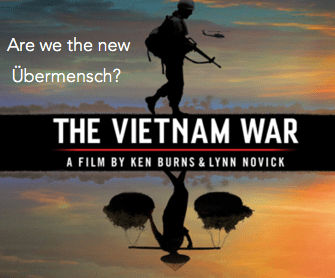
The Vietnam War: A film by Ken Burns & Lynn Novick – Are we the new Übermensch?

The Vietnam WarI applaud Ken Burns and Lynn Novick for their epic work and for rebooting the discussion about this tragic chapter in world history. For a film made in America, it’s likely as balanced an interpretation of the Vietnam war as we’ll see in a hundred years.

The many interviews with surviving combatants – North and South Vietnamese, Viet Cong, and American – as well as journalists, government experts, and historians, was moving. But, I think the series fell short in two areas.

First, it failed to dispel the oft-cited belief that the US’s entry into Vietnam was necessary to stop the spread of communism. Without a doubt this view was widely espoused as fact by our government and considered true by the vast majority of Americans at the time of the Vietnam war and, for those entrenched in past dogma, remains true today.

I saw this error coming when I read the title for Episode 1: Déjà vu (1858-1961). It was important that the film went back to the start of French colonialism, but here it also failed in a very significant way to inform the viewer of Vietnam’s long history of conflict with China. A 10-minute segment in Episode 1 could have explained the centuries of friction between Vietnam and China that predated the French. Focusing the spotlight on this aspect of Vietnam’s history brings out a vital point missed in our assessment of the war: Vietnam was no more interested in being occupied by China than by France, Japan, or the United States. Communism for the Vietnamese, and Ho Chi Minh in particular, was a means to an end, a road to independence. Little more.

Continue reading The Vietnam War: A film by Ken Burns & Lynn Novick – Are we the new Übermensch?

Another version of the American version of another American war

Last week I watched the preview of Ken Burns’s upcoming documentary, The Vietnam War, scheduled to start Sunday, September 17 on PBS.

While there were some moving segments in the preview, I was left feeling that the Burns documentary may turn out to be yet another version of the American version of another American war.  Excuse my wordiness but read on and you’ll get my point.

It is perhaps unfair to judge a 10-part 18-hour documentary based on a 23-minute preview, but in it I see symptoms of what I would describe as a kind of knee-jerk sentimentality that makes war an acceptable and often glorified, part of American culture.

Burns The Vietnam War

Ken Burns and Lynn Novick are self-proclaimed storytellers, and very good at it. But that’s where the problem starts: with the notion that war is yet another “story” – a term they often use in the preview. It’s from this perspective that war begins to take on romantic appeal; something that young people without parenting, a cause, direction, or education will cling to when all else fails.

Exposing the clouded lens through which his documentary is made Burns says: “Wars are so extraordinarily revealing. Obviously, the worst of humanity, but as it turns out also the best of humanity.”  Really?

I would argue that using the phrase “the best of humanity” in the context of war is delusional. It is yet more storytelling about how people react in a time of horror when adrenalin is coursing through their veins. The same happens during a car wreck, a plane crash, or a terrorist attack. We don’t glorify these tragic events, so why do we glorify war?

Continue reading Another version of the American version of another American war

July 4th Postmortem: A Declaration of Equality

Discussing the war in Vietnam will never be an easy subject.

Unlike World War I that started with the assassination of Austria’s Archduke Ferdinand, and World War II that started with Germany’s invasion of Poland, the events that led to our war in Vietnam remain a source of controversy. Unraveling these events into a cohesive storyline will likely never happen.

Adding to this problem is a general indifference to history – including our own – and a preference for trite explanations and sound bites that conform to the country’s predominantly patriotic narrative.

Events like July 4 give us an opportunity to put all this aside and to recall what we do know.

First, our founding fathers were extraordinary humans whose thoughts, words, and actions have transcended the ages. We may veer off course, but we have the bedrock of the Declaration of Independence, and its Preamble, to set us right again.

We hold these truths to be self-evident, that all men are created equal, that they are endowed by their Creator with certain unalienable Rights, that among these are Life, Liberty and the pursuit of Happiness.

Second, in the heat of fighting communism, much like today’s “war on terror,” the Preamble is considered restricted to Americans only, and not “all men,” as it reads.

Should we take the Declaration of Independence literally, and choose to honor the men who signed it, we are compelled to think of the enemy as equal to our own. It’s not an easy notion to accept, but we must if we are to remain true to the idea of America.

Continue reading July 4th Postmortem: A Declaration of Equality