True Heroes

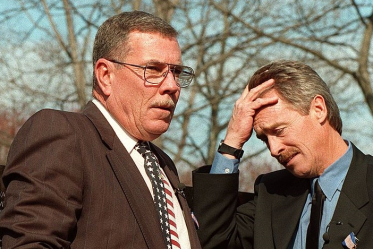
Hugh Thompson+Lawrence Colburn
http://www.khaosodenglish.com/news/international/2016/12/16/lawrence-colburn-vietnam-war-hero-67/

A true hero is a person who takes their commands from a higher authority. Relying on a deeper sense of right and wrong, he doesn’t always follow orders. Hugh Thompson and Lawrence Colburn are examples of this.

They put their lives on the line – confronted their fellow soldier – and put an end to the bloody rampage known as the My Lai massacre.

Hugh and Lawrence lived by the creed of Five-Star General, Douglas MacArthur, who said “The soldier, be he friend or foe, is charged with the protection of the weak and unarmed. It is the very essence and reason of his being. When he violates this sacred trust, he not only profanes his entire cult, but threatens the fabric of international society.

They did right and now rest in eternal peace. Hugh and Lawrence represent the best of mankind.

King’s most moving sermon on Vietnam

No one spoke with greater conviction against the war in Vietnam and in defense of all victims – foreign and domestic – than Dr. Martin Luther King, Jr.

Less than a year before his assassination, on April 30, 1967, King made one of his most remarkable sermons ever, explaining why he opposed the war in Vietnam. As with his famous “I Have a Dream” speech, Dr. King demonstrated his ability for thinking in broad terms, and in ways that united all who listened. He spoke not just of those directly affected by the war, but also of its impact on society, justice, and world order.

His points are timeless and apply equally to our current conflicts in the Middle East, as they did to the war in Vietnam.

His most profound message is directed towards those young men and women who are thinking of going to war, believing that their greatest purpose in life is to serve their country and to do so without question. To this King says: “Every man has rights that are neither conferred by nor derived from the State – they are God-given.

In other words, he implores us to put moral conviction – that which is instilled in us by our Creator at birth – before government and patriotic symbolism.

Below is an abbreviated version of King’s sermon.


Revisionism and Rationalization

… we are quick to seek pity, as if the Vietnamese had invaded our country, but seem to have little capacity to feel pity for the lives we took.

Historians call it “revisionism” when events are redefined to fit a particular narrative.*

In psychology, the term “rationalization” is used in a similar context to explain away bad behavior; some call it excuse-making.

Both words underscore a human need to maintain a feeling of contentment with who we are, what we have done, and how we think. We generally don’t question our beliefs, because doing so works against our state of well-being. Questioning stokes doubt and provokes unrest, or what psychologists call dissonance.

Unfortunately, for some this blog is a source of dissonance. It questions many of the assertions about the Vietnam War that have been repeated so often, and with such conviction, that we have come to accept them as absolute truths.

While many acknowledge the tragedy that was the Vietnam War, more react with denial, and at times anger, at the suggestion that America did wrong. Rather than recognizing the estimated 2 to 3 million men, women, and children killed during our time in Vietnam as our human equals, we remain fixated on the 58,200 American lives that are memorialized in Washington. Continue reading Revisionism and Rationalization

A Time to Regret

I closely track stories about Vietnam, and hardly a day passes when I don’t read an article honoring our Vets. Here’s a short sampling of what I mean, all published on October 12, 2016:

“Event to honor local Vietnam War Veterans on Thursday” Knoxville News Sentinel

DAR honors Vietnam War vets with tree planting” Richland Source

The Moving Wall-Residents honor Vietnam War Heroes” King City Rustler

Do Vietnam Vets really want to be honored, when so many feel regret? Are we not doing them, and ourselves, a disservice by not recognizing the horror that was the Vietnam War? Wouldn’t the conscience of the Vietnam Vet, and the nation as a whole, be better off if we recognized the holocaust that became the war in Vietnam?

Like so many of our politicians, and the powerful business elite we, as a nation, seem never to be wrong. We have lost the moral conviction to admit we did bad, and to ask for forgiveness. Worse yet, we have grown indifferent to the truth and to putting forward any effort to discovering it. Honoring Vets for a war we know nothing about – and care to know nothing about – is an easier course to take, and conveniently doesn’t put a dent into the smooth flow of patriotism that makes us feel good about being American.

Continue reading A Time to Regret